

Books that Changed How I Look at Money
I got interested in money pretty young. And no, I’m not talking about lemonade stands and allowance. My mom gave me a book for my 14th birthday (stay tuned for which one) and I remember getting halfway through and going,
“Why aren’t I learning this in school instead of algebra? When am I ever going to use algebra?”
Turns out, I was pretty spot on. And I really wish more schools would teach some basic personal finance way younger to give more people (especially women) confidence in their knowledge about personal finance. So I’ve continued to add to my knowledge over time, through my favorite source of new knowledge: books!
Now let’s get a couple of things clear (I’ve said some of these things before but they bear repeating):
Most importantly, I am not a financial advisor nor a fiduciary. I have no formal training so on all things money, please speak to an expert or do your own independent research!
Everybody starts from a different place of knowledge on this topic and there is nothing wrong with starting with a little less knowledge. All that matters is you’re pushing yourself to learn more. I have so much to learn and am still constantly asking people I trust to explain new topics to me. I share all of this in the same spirit - you are already doing amazing things by being here and trying to learn.
No financial advice is one-size-fits-all. Even in these books written by experts or that article about the next big stock or investment everybody’s talking about, it’s all about tracking back to your individual goals. Own them and do what’s right for you. FOMO is personal finance can be an expensive mistake.
Money gives us the freedom to live us the lives we’ve always dreamed of.
Okay, let’s get to the matter at hand. You’re looking for the best books on money. But you’re probably not 14 anymore, like I was when I started become a nerd on this topic. Lucky for you, I’ve kept reading books on money long past the age of 14 and I’ve collected my best money books for adults that I’ve personally read and found useful throughout my life. So without further ado…

MY FIRST BOOK ABOUT MONEY (THE ONE THAT STARTED IT ALL!)
Girls Just Want to Have Funds by Susannah Blake Goodman
So let’s be real, I read this when I was 14 but because it clearly resonated with me, I have to share it. Caveat, I read it a long time ago and even then I remember some of the stories/examples being a little kitchy even then. So if that stuff bugs you, keep that in mind. But this did something to get me to care at age 14 when money isn’t on most girl’s (or kids in general) mind.
THE BEST MONEY BOOK FOR BEGINNERS
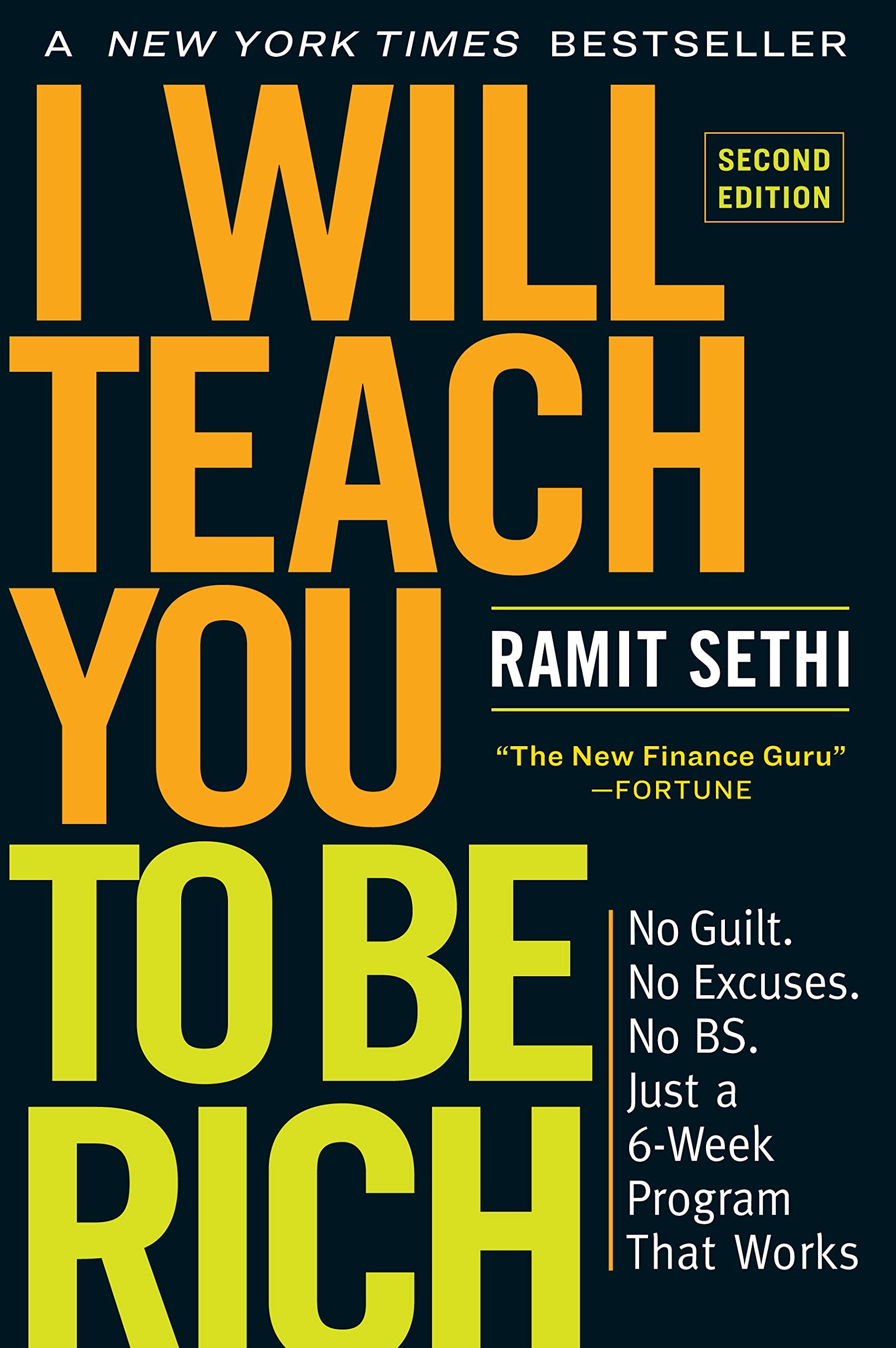
I Will Teach You to Be Rich by Ramit Sethi
If you feel like you’re a beginner, or just feeling a bit overwhelmed, this is the #1 recommendation I would give. Ramit is now a world famous money expert because of his ability to break things down in a really manageable way.
This book walks through budgeting, saving, investing and overall money mindset in a way that gives a powerful foundation for anybody who wants to level up your money life. Because it gives such a thorough foundation, I think everybody will find something useful in it (I did even though I was relatively advanced on the money sophistication meter). But especially for beginners, this will help you get your head screwed on straight!
THE BEST MONEY BOOK FOR WOMEN
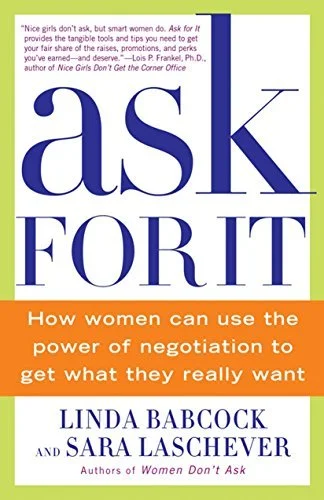
Ask For It by Linda Babcock and Sara Laschever
This one changed the game for me immediately. I could talk about this book for hours. I wanted to make an aggressive ask at work (I knew I could handle a job that was a significant promotion but unprecedented for the company). Without exaggeration, I read it top to bottom in one day. Linda Babcock is an incredibly accomplished psychologist who has studied negotiation, especially as it relates to bias.
This does an incredible job explaining the basics of negotiation strategy, with some really practical context as to the (unfortunate) bias that women often face. You might be thinking, “but I wanted books about money, not negotiation?” and to that I would say that learning to negotiate is one of the most powerful money strategies you can have in your life.
(Spoiler alert - I used her tips in the negotiation for the job and got the promotion and a raise. I gave it to all my best friends as their Christmas gift that year.)
THE ONE THAT BLEW MY MIND
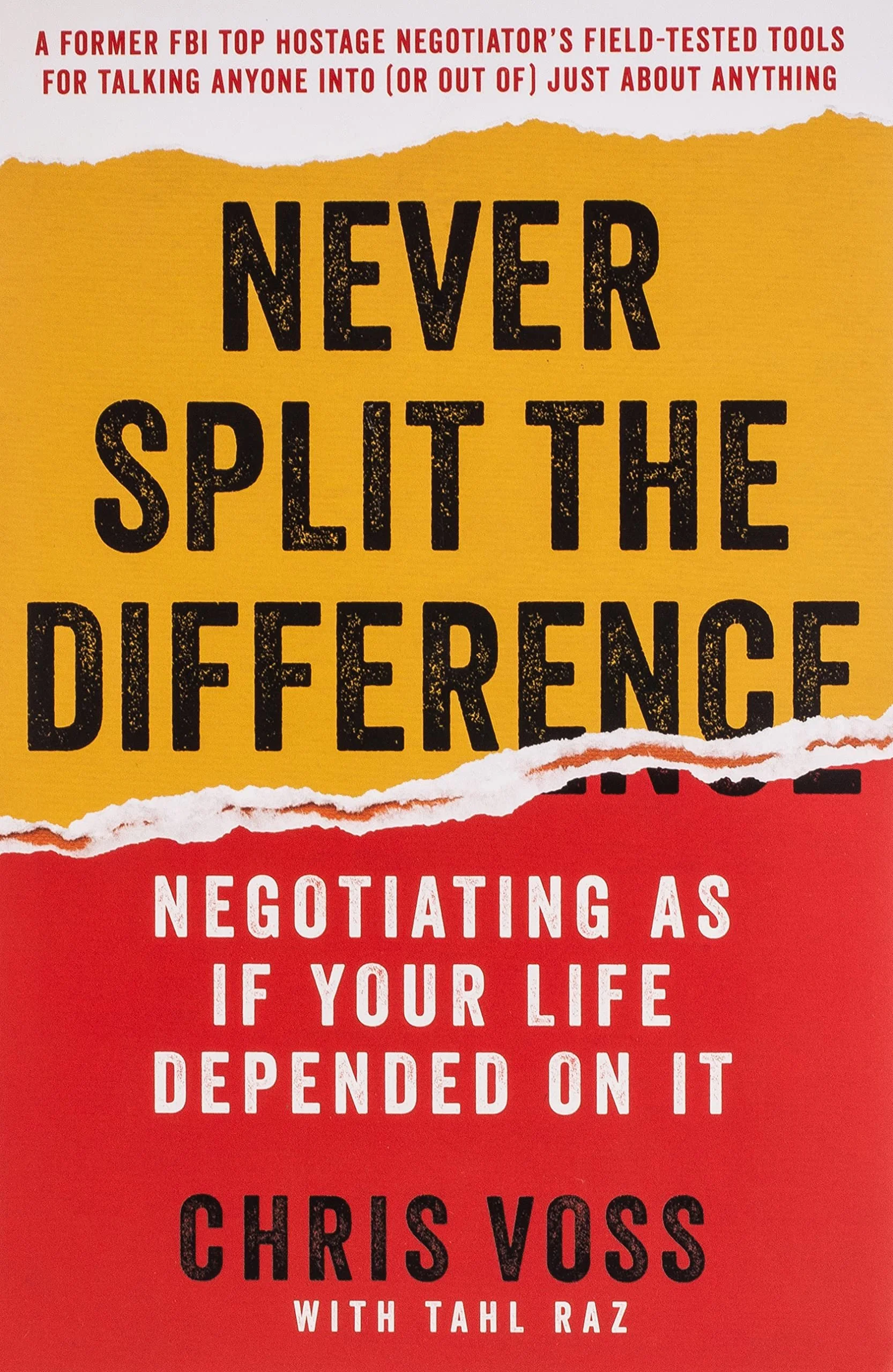
Never Split the Difference by Chris Voss
This is a “do not pass go” book but I do recommend it once you have a little bit of a baseline on negotiation. That said, it’s so entertaining because it’s written by a former lead hostage negotiator for the FBI (so it turns these concepts basically into an action movie). This book acknowledges the human/emotional side of negotiation. Negotiation and money are obviously not the same thing but they’re so closely linked and this book is potentially my most recommended book of the last 3 years so I have to include it!
Real world proof point: my roommate used one tip from the first chapter on a call to negotiate salary on a job she had just gotten offered (I was so into it, I had to start talking about it immediately, even one chapter in) and 30 minutes later, she walked out of her room, sort of dazed and said “I used that thing you said and… it worked!”
Frequently Asked Questions
Why should I read books about money at all?
Books on money do more than teach budgeting or investing tactics, they help you understand how money works and the mindsets that shape how you think about financial decisions. Good money books help you identify behavioral biases, long-term planning habits, and systemic patterns that most people never consciously articulate. They can accelerate your learning curve by years compared to trial and error in real life.
There is always the caveat though that if you read a book but make no changes, it’s not likely to dramatically change your life. A book can be the perfect resource, especially since they’re generally affordable, for you to wrap your head around things but then it’s on you to start making changes. You got it?
What’s the best money books for a beginner? What should I read first?
In my opinion, if you are over the age of 17, you should start with I Will Teach You To Be Rich by Ramit Sethi. This book walks through budgeting, saving, investing and overall money mindset in a way that gives a powerful foundation for anybody who wants to level up your money life. It’s also approachable and an easy read.
What’s the difference between money books, personal finance books and investing books?
Money is a biiiig topic. It can’t all be covered in one book. I would consider “money books” the largest umbrella because it covers making money, spending money, saving money, investing money, and thinking/talking about money.
If you’re interested in more specificity, personal finance books typically cover fundamentals like budgeting, saving, debt management, and financial planning for individuals. Personal finance books tend to discuss investing but it’s only one fo the topics that is covered so it’s limited in depth. Investing books dive deeper into the specifics of investing like markets, asset allocation, and portfolio strategies. They’re often espousing a specific strategy that you need to weigh carefully against your goals and lifestyle, whereas personal finance books are more likely to apply to most people.
There are also finance books related to businesses, rather than individuals. Obviously, if this is an area of interest, then there is so much to learn but if you are focused on making or having more money yourself, these are not the place to start for you!
How do I know when I’m ready to move to more advanced books?
Whether it’s an advanced investing books or diving into negotiation, it often makes sense to have some fundamentals so you aren’t having to google terms at every turn. My recommendation is to make sure you have an understanding of key terms, have your basic accounts set up and be able to overall summarize your goals for spending, saving and investing (even if you’re still working toward saving that emergency fund, for example) before you move on to more advanced books.
Are some money books overrated or outdated?
Yes - criticism exists for many popular titles. For example, Rich Dad Poor Dad has been widely praised for mindset shifts but also critiqued for vague or overly simplified advice. But this is where you need to use your smarts - books are just a source of information and even the best, newest book will only help you as much as you implement it.
Rather than taking any single book as gospel, consider:
What specific financial behavior or skill you want to improve.
Whether the book’s worldview aligns with your goals (e.g., conservative investing vs entrepreneurial risk-taking).
What evidence or logic the author uses to support claims.
How much will reading these books actually change my financial situation?
Reading changes thinking; action changes results. Books are tools to build mental models and habits. If you take insights and apply them consistently (e.g., automate savings, adjust investment allocations, rethink spending), the impact compounds over years. If you just read the book and do nothing with it, they’ll just be onther expense on your budget for the year.
That’s why I always recommend reading fewer resources and putting energy into implementing them, rather than binging content. It can be too easy to feel productive because you read another book, but if you didn’t make any changes, then it didn’t do you much good.
A useful test: when you finish a book, set a reminder on your phone for two weeks later to check in with what you’ve implemented. If that ping goes off and you realize you haven’t implemented much, then don’t start another book until you’ve gone back to the first one and implemented some of the tips! after finishing a money book, write down three specific changes you will make in the next 30 days.
Can money books become repetitive or redundant?
Many core principles - spending less than you earn, investing early, and understanding psychology - are repeated across titles. However, each author frames these themes differently. Some focus on mindset, others on practical systems, and still others on behavioral economics.
But sometimes we have to hear things different ways for new concepts to click. That said, this is where the previous question applies: are you consuming or are you actually implementing?
It’s okay if books start to feel redundant because you’ve already implemented most of the advice. But if they are saying the same things and you haven’t made any of the changes, it’s time to look at how we might be using books as distractions from doing the harder implementation work.

